How to Import and Register a European Truck in Spain
Buying a used truck in another European country can give you access to a wider choice of brands, configurations and equipment. Before putting it to work in Spain, you need to check the paperwork, pass the import ITV inspection and complete the tax and registration formalities. In this guide we explain how to import and register a used truck in Spain, which documents you need, how much the main steps can cost and what to check before you buy.
Why is it worth importing a heavy vehicle?
Before getting into the process, it helps to understand why so many Spanish companies buy trucks in countries such as Belgium, Germany, the Netherlands or France:
- No registration tax: N2 and N3 category goods vehicles are not subject to the Special Tax on Certain Means of Transport (IEDMT, Spain's registration tax). For these vehicles, the Spanish Tax Agency uses Form 06 (Modelo 06) to declare that the tax does not apply. Trailers and semi-trailers are not subject to this tax either.
- VAT depends on how the sale is invoiced: when a Spanish company with an EU VAT number buys from a company in another Member State under the general scheme, the intra-community acquisition is declared in Spain and the VAT can be deductible if the tax requirements are met. For used vehicles sold under the margin scheme for second-hand goods (REBU), the treatment is different, so check the invoice and the tax scheme applied.
- More choice and a wider range of specifications: the European market offers a large selection of used trucks and tractor units, including many Euro 6 vehicles with different configurations and levels of equipment. The emissions standard can also affect certain toll systems and environmental restrictions, depending on the country.
- Ready for international transport: heavy vehicles registered for the first time from 21 August 2023 must be fitted with a second-generation smart tachograph. Since 19 August 2025, heavy vehicles carrying out international transport within the EU must be equipped with this version of the tachograph.
How does the truck get to Spain?
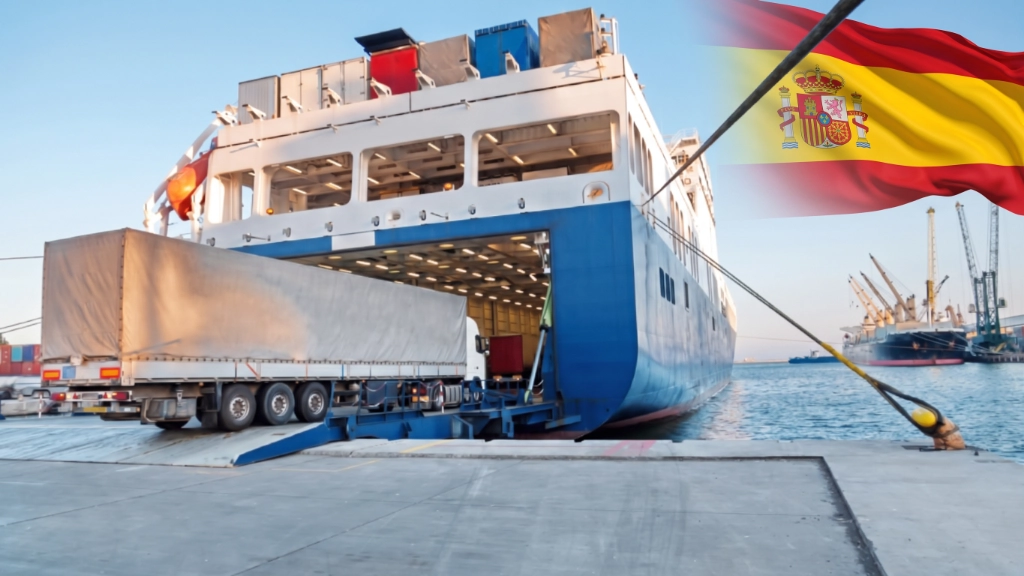
One of the most common ways to transport a truck from Belgium and other parts of northern Europe to Spain is by sea, on a ro-ro (roll-on/roll-off) ship, to the port of Santander or the port of Vigo. The vehicle drives on and off the ship under its own power, with no need for a container.
Want to know how much it costs to bring one of our trucks to Santander or Vigo? Talk to our team and get a quote.
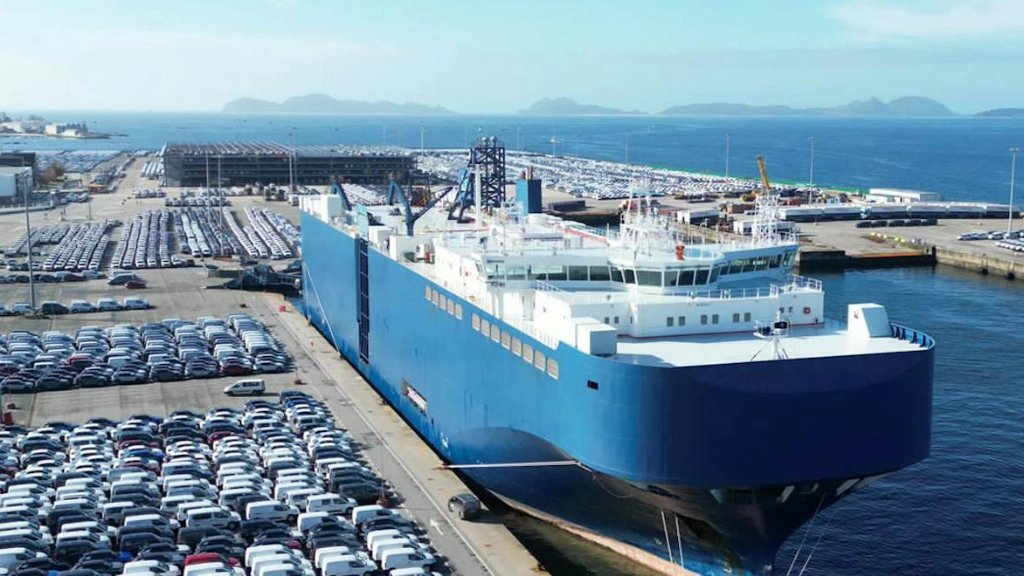
- The connections:
- The cost: shipping a tractor unit from Belgium to Santander or Vigo is quoted according to dates and vehicle type. Ask us for a quote.
- The advantage: sea transport avoids most of the road mileage and reduces the wear and tear of moving the vehicle. From Santander, the motorway network connects to Bilbao, Burgos, Valladolid, Zaragoza and Madrid. Vigo is more practical for Galicia, north-west Spain and northern Portugal, with motorway links to Santiago, A Coruña, Ourense and Madrid.
TheTruckCompany is headquartered in Hooglede (Belgium), less than an hour from the port of Zeebrugge, which makes this route especially easy for anyone buying from us.
Routes, frequencies and transit times may vary depending on the date and the carrier's operations. Confirm the specific conditions when requesting a quote.
There are other options too:
- By road, on a car transporter or low-loader: useful for vehicles that are not roadworthy or for door-to-door deliveries.
- Driven, with export plates: the truck is driven to Spain on temporary plates issued in the country of origin, with insurance covering the days of the journey.
Keep the transport document. Whether it is the ship's bill of lading or the CMR consignment note for road transport, this document proves when and how the truck entered Spain. Keep it in the folder with the rest of the paperwork.
From the port to the ITV. Until it has Spanish plates, the truck cannot be driven on public roads. It is taken to the ITV on a low-loader or, if it arrives driven, on the temporary export plates from the country of origin, as long as they are still valid and insured. The DGT's green plates (a temporary 60-day driving permit, which can be extended) allow the truck to be driven once the registration application has been submitted, while the final registration is being processed.
Truck registration step by step
The process starts with the documents that come with the truck: the invoice, the registration certificate from the country of origin and the relevant technical and type-approval documents.
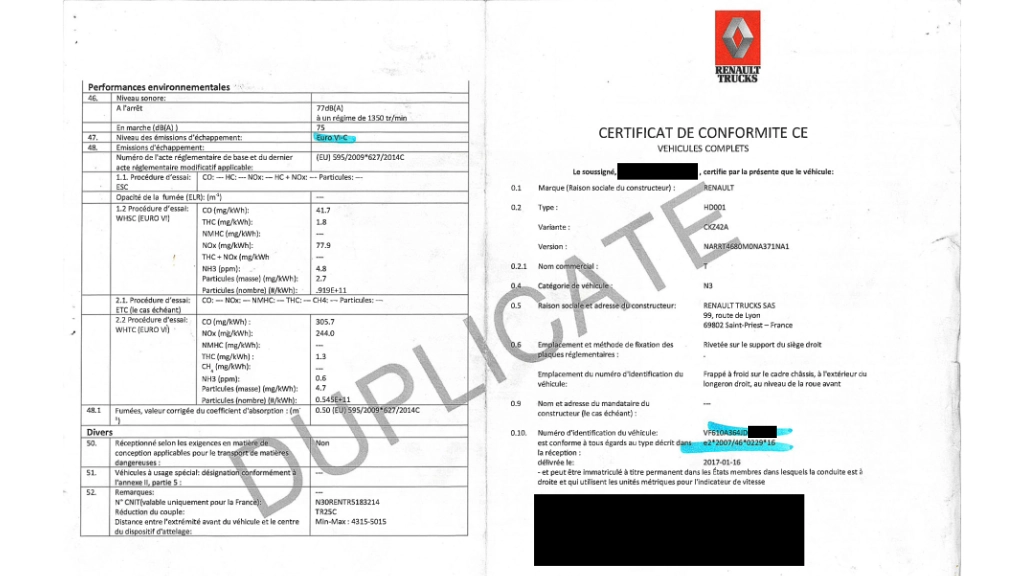
When the vehicle has EC type-approval and a COC (European Certificate of Conformity), the COC can be used instead of the reduced technical data sheet (ficha reducida) for the ITV. If there is no COC, a reduced technical data sheet or other type-approval documents may be required. In some cases, especially when there is no valid European type-approval, a specific type-approval may be needed. That is why it is worth checking the vehicle's situation before buying it.
1. Import ITV inspection and Spanish ITV card
The truck undergoes a pre-registration inspection at an ITV station (Spain's vehicle inspection). It is more thorough than the periodic inspection: it checks that the vehicle matches its documents, its safety condition and its emissions. If the result is favourable, the station issues the ITV card (technical data sheet) in Spanish format, the technical document the DGT will need.
Remember: without Spanish plates, the truck cannot be driven under its own power. Take it to the ITV on a low-loader or, if it arrives driven, on its valid and insured temporary export plates.
2. Registration tax (Form 06) and road tax
Before going to the traffic authority, the tax side has to be sorted out:
- Form 06 (Spanish Tax Agency): declares that the registration tax does not apply when the vehicle falls within the relevant cases, such as N2 and N3 category goods vehicles. In the Basque Country and Navarre, it is filed with the corresponding regional tax authority (Hacienda Foral). Trailers and semi-trailers are not subject to the IEDMT and do not need this form.
- IVTM (road tax): must be paid to the relevant town council before registration, according to its local rules. The amount depends on the class and characteristics of the vehicle and on the coefficient applied by the town council.
A gestoría (an administrative agency that handles vehicle paperwork) normally takes care of both.
3. Registration with the DGT
With the ITV card, the relevant tax documents and proof of IVTM payment, you apply for registration with the DGT (Spain's Directorate-General for Traffic), in person or through the available online channels. You submit the original documents from the country of origin, the invoice or bill of sale and the required documents for the owner or company. The registration fee for other vehicles is currently €99.77 (fee 1.1). The DGT assigns the registration number and issues the registration certificate (permiso de circulación).
4. Number plates and tachograph
Once the registration number has been assigned, the plates can be made at any authorised supplier, usually on the same day. With the plates fitted and insurance in place, the truck can be driven under its own power. For vehicles with a tachograph, there is one more technical step: an authorised tachograph workshop updates the unit with the new Spanish registration number.
5. Adding the truck to the transport licence
If the truck will be used for hire-or-reward goods transport, it must be included in the company's transport licence (MDPE) and have the corresponding certified copy for that vehicle. This is handled by the competent transport authority of the autonomous community. For own-account transport, different rules may apply.
What changes depending on the type of vehicle
The steps are the same for any heavy vehicle. What changes is what the ITV focuses on and which extra documents are worth having to hand.
Tractor unit
- Documents: invoice, original registration certificate, COC and transport document (CMR or bill of lading).
- ITV: focuses on emissions (Euro standard), the braking system, the fifth wheel where the semi-trailer is coupled, and the presence and sealing of the tachograph.
- After registration: the tachograph workshop updates the unit with the Spanish registration number.
Rigid truck (with body)
- Documents: the same as for a tractor unit. If the body (for example, a refrigerated box) is not listed on the chassis COC, also ask for the bodybuilder's certificate.
- ITV: in addition to the engine, brakes and tachograph, the inspection checks that the chassis and body combination matches the documents, including weights and dimensions. If the body is not covered by the type-approval, an individual type-approval may be needed: check with your gestoría before buying.
- Refrigeration: for transporting perishable goods, the ATP certificate is handled through a separate procedure, in parallel with the registration.
Semi-trailer or heavy trailer
With no engine, this is the simplest process of the three.
- Documents: invoice, original registration certificate, semi-trailer COC and transport document.
- ITV: no emissions or tachograph. The inspection covers braking (EBS/ABS), lighting, suspension and the kingpin.
- Taxes: not subject to the registration tax (IEDMT) and does not need Form 06. It is subject to the IVTM, based on its payload and the rules of the relevant town council.
- Its own registration: the semi-trailer receives its own Spanish registration number, separate from the tractor unit's.
How much does it cost to register an imported truck?
There is no single cost for registering an imported truck. The total depends on the vehicle, the autonomous community, the type-approval situation, transport, the tax scheme of the purchase and any gestoría or tachograph services required. As a guide, for a tractor unit from Belgium with a COC, the formalities in Spain usually add up to roughly €700 to €1,300, excluding transport.
| Expense | Approximate amount (2026) | Notes |
|---|---|---|
| Transport Belgium → Santander or Vigo (ro-ro) | ≈ €1,000 – €1,500 | Depends on date, route and vehicle characteristics |
| Registration tax (IEDMT) | €0 | N2/N3: not applicable; Form 06 where required |
| Import ITV inspection | ≈ €120 – €260 | VAT included; varies by autonomous community and ITV station |
| Reduced technical data sheet (only if there is no COC) | ≈ €150 – €250 + VAT | Signed by an engineer; an individual type-approval costs considerably more and is quoted separately |
| DGT registration fee (fee 1.1) | €99.77 | Official amount for other vehicles |
| Green plates (optional) | €20.61 fee + ≈ €100 handling | To drive once the application has been submitted |
| IVTM (tractor unit) | ≈ €83 – €167/year | Depends on the municipal coefficient; the first year may be prorated |
| Gestoría | ≈ €150 – €400 + VAT | Check which formalities are included (Form 06, IVTM, DGT, transport card) |
| Number plates | ≈ €20 – €40 | Set of plates |
| Tachograph update | ≈ €165 – €200 + VAT | Inspection with calibration at an authorised workshop |
| VAT | Depends on tax scheme | May be an intra-community acquisition or REBU, among other cases |
For comparison, the national base IVTM rate is €148.30 for trucks with a payload above 9,999 kg, €83.30 for tractor units (taxed as tractors, in the band above 25 fiscal horsepower) and €83.30 for trailers and semi-trailers with a payload above 2,999 kg. The relevant town council can apply the coefficients allowed by law, so the final amount may be higher.
Essential documents
Put together a folder with these documents before the truck arrives. It is the best shortcut to a quick process at the ITV, the tax office and the traffic authority.
- Purchase invoice, with both parties' VAT numbers and the tax scheme stated (intra-community transaction or REBU)
- Original registration certificate from the country of origin
- Certificate of Conformity (COC) where available, or the reduced technical data sheet/type-approval documents as applicable
- Transport document: bill of lading (ro-ro) or CMR consignment note, where applicable
- Spanish ITV card issued by the ITV station
- Form 06 declaring that the registration tax does not apply, where applicable
- Proof of IVTM payment required for registration
- Company documents: CIF (tax ID), articles of incorporation or power of attorney and the representative's ID
Deadlines to keep in mind
Deadlines depend on the formality. These are the main points to keep in mind:
| Stage | Deadline / timing | Authority |
|---|---|---|
| Green plates (temporary permit) | 60 days, extendable | DGT |
| Form 06 | Before registration is completed, where applicable | Spanish Tax Agency |
| IVTM | Before registration | Town council |
| DGT registration | Once you have the ITV card and have completed the required tax documents | DGT |
| Tachograph update | After the new registration, where required and before carrying out the relevant operations | Tachograph workshop |
| Adding the truck to the transport licence | Before starting hire-or-reward goods transport, where applicable | Transport authority of the autonomous community |
Registration agencies by region
A gestoría handles Form 06, the IVTM, the DGT, the green plates and, in many cases, the transport card. Several work remotely across the whole of Spain. We have gathered a few names by region to make the first contact easier:
| Region | Company | Location | Contact |
|---|---|---|---|
| North | Gestoría Estela Criado | Santander (Cantabria) | +34 942 33 00 77 |
| Centre | Car Import Gestión | Madrid | +34 915 943 190 |
| East | Gevepro | Barcelona (service across Spain) | +34 629 07 24 25 |
| South | Tevagui Gestores | Seville (service across Spain) | +34 955 676 001 |
Indicative list, with no commercial relationship with TheTruckCompany. When asking for a quote, confirm their experience with heavy goods vehicles.
What to check before buying a used truck in another European country
Registration starts before you buy the vehicle. Before closing the deal, it is worth checking:
- VIN and documents: that the chassis number matches all the documents.
- COC and type-approval: confirm that the technical documents needed to register the vehicle in Spain exist.
- Specifications: check weight, number of axles, power, dimensions, Euro standard and configuration.
- History: review the available maintenance, mileage and inspection records.
- Tax scheme: confirm how the sale is invoiced and whether the general scheme or REBU applies.
- Total cost: in addition to the purchase price, take into account transport, ITV, DGT, IVTM, gestoría, plates and any type-approval or tachograph costs.
Buying a used truck with the right documents can save you extra formalities and unexpected costs during registration.
Conclusion
Importing a used truck into Spain means coordinating the ITV, the tax side, the DGT and, where applicable, the transport and tachograph formalities. With the right documents and good planning, the process can run smoothly and without unnecessary steps.
At TheTruckCompany, headquartered in Belgium and in the business since 1974, we hold a permanent stock of used tractor units, trucks and semi-trailers, and we arrange delivery to Spain. Every vehicle comes with the available documents and, whenever applicable, its COC.
Browse our used heavy vehicles in stock or talk to our team to find out about the available options.
Note: procedures, fees and requirements may change. Before starting a process, confirm the current conditions with the DGT, the Spanish Tax Agency, your town council and the transport authority of your autonomous community. The VAT treatment and other tax aspects depend on the specific transaction.