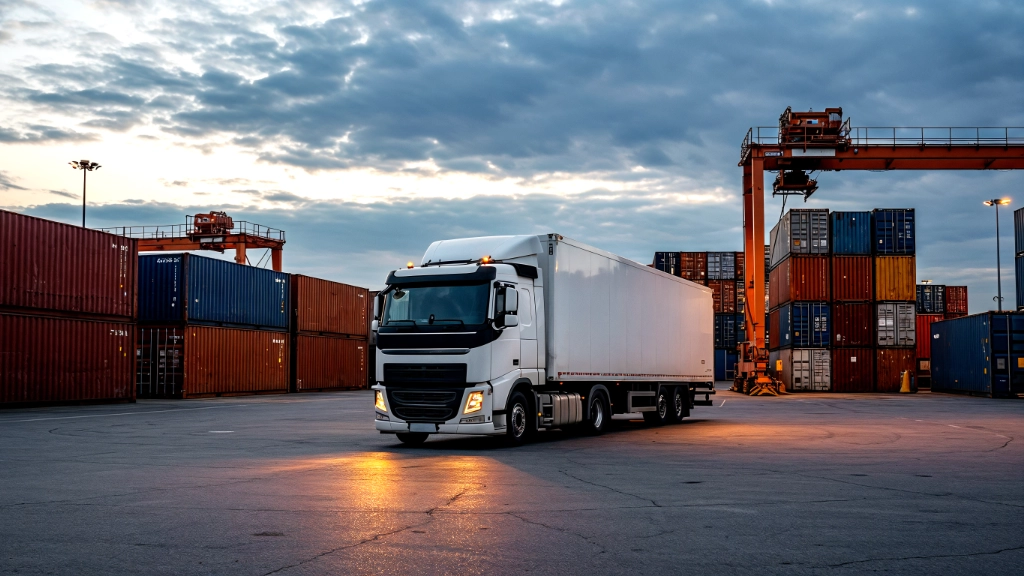
Complete Guide: How to Import and Register a European Truck in Portugal
Importing a truck from another European country is now one of the smartest ways to renew or expand a fleet. There is more choice, better specifications and, for heavy goods vehicles, no ISV (Imposto Sobre Veículos, Portugal's vehicle registration tax) to pay. In this guide we explain how the truck gets to Portugal, how it is registered step by step and how much it costs, along with a list of customs agents by region to help you through the process.
Why import a heavy vehicle?
Before we get into the process, it's worth understanding why so many Portuguese companies choose to buy trucks in countries such as Belgium, Germany, the Netherlands or France:
- No ISV to pay: unlike passenger cars, heavy goods vehicles, tractor units and semi-trailers fall outside the scope of ISV. Clearing customs is a formality, with no tax to settle.
- VAT at no cost to the company: when a Portuguese company with a valid VAT number in VIES buys from a company in another Member State, the invoice is issued without VAT and the tax is self-assessed (reverse charge) in Portugal. As long as the truck is used for the business, that VAT is deductible.
- More choice and better specifications: the European market has a huge supply of Euro 6 tractor units and trucks with service history and full equipment. A Euro 6 truck uses less fuel and pays lower tolls in several countries, such as Germany, where the HGV toll depends on the emissions standard and CO₂ class.
- Ready for international transport: many recent European trucks already come with the second-generation smart tachograph, mandatory on heavy vehicles first registered since 21 August 2023 and in all international transport since 18 August 2025.
How does the truck get to Portugal?
The most practical way to bring a truck from Northern Europe is by sea, on a RoRo (roll-on/roll-off) vessel, to the port of Leixões in Matosinhos. The vehicle drives on and off the ship under its own power, with no cranes or containers.
Want to know how much it costs to bring one of our trucks to the port of Leixões? Talk to our team and get a quote.
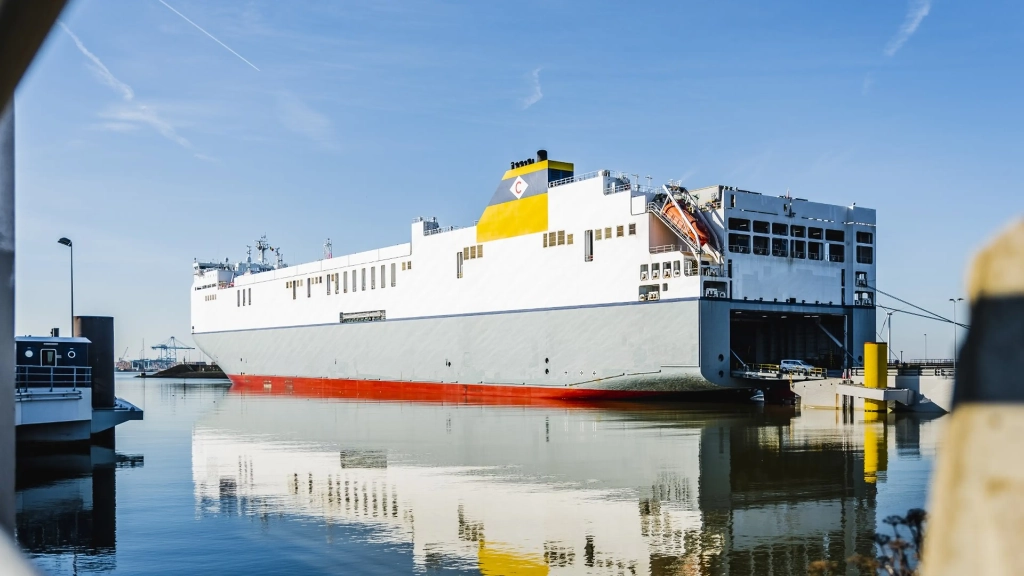
- The route: CLdN operates two weekly RoRo sailings in each direction between Rotterdam, Zeebrugge and Leixões. The Zeebrugge–Leixões crossing takes about three days.
- The cost: shipping a tractor unit from Belgium to Leixões typically costs between €1,000 and €1,500.
- The advantage: the truck arrives with no extra kilometres, no wear and tear and no driver covering 2,000 km of road. Leixões sits on the doorstep of Greater Porto and the motorway network of northern and central Portugal.
TheTruckCompany is headquartered in Hooglede, Belgium, less than an hour from the port of Zeebrugge, which makes this route especially simple for anyone buying from us.
There are other options too:
- By road, on a low-loader: useful for vehicles that can't be driven or for door-to-door delivery.
- Driven, on export plates: the truck is driven to Portugal on temporary plates issued in the country of origin.
Keep the transport document. Whether it's the ship's bill of lading or the CMR consignment note for road transport, this document proves the date and manner of the truck's entry into Portugal. Customs will ask for it along with the other documents.
From the port to inspection, on a low-loader. During the registration process, and until it has Portuguese plates, the truck cannot be driven on Portuguese roads. It is therefore moved from the terminal to the inspection centre on a low-loader. Book the inspection before the ship arrives and the truck can go straight from the port to the centre. The rest of the process is paperwork and is handled with the truck parked.
Step-by-step truck registration
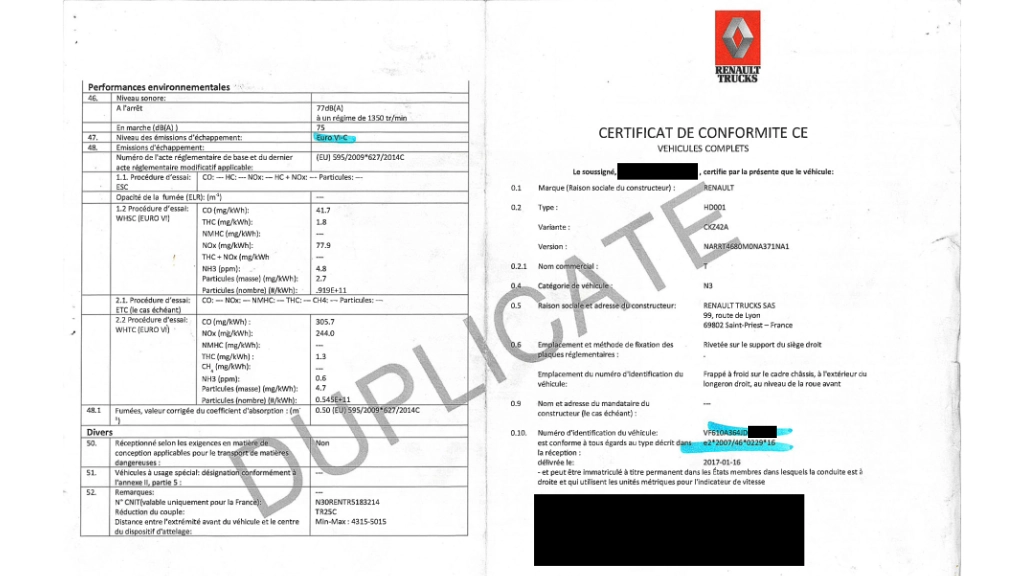
The process is clear and always follows the same order. It all starts with the documents that come with the truck: the invoice, the registration certificate from the country of origin and the COC (European Certificate of Conformity).
With the COC, the IMT can quickly identify the vehicle's type approval, making the process simpler and cheaper. If the truck has no COC, the type approval from the country of origin is submitted instead, and the process carries on as normal. With the right paperwork, an imported heavy vehicle is usually registered within a few weeks.
1. Registration inspection (Category B)
The truck is inspected at a Category B Inspection Centre. This is a more thorough inspection than the periodic one: it checks the vehicle's technical characteristics, emissions and safety against its documents. On approval, a Modelo 112 Inspection Certificate is issued, valid for 90 working days.
Remember: until it has Portuguese plates, the truck cannot be driven under its own power. It travels to the inspection centre on a low-loader and only goes back on the road once it has its plates and insurance.
2. Customs clearance (DAV)
The DAV (Declaração Aduaneira de Veículo, the vehicle customs declaration) is submitted online on the Portal das Finanças (the Portuguese tax portal), usually through a customs agent. As heavy goods vehicles and trailers are outside the scope of ISV, there is no tax to pay: the DAV records the truck's entry, and Customs assigns the registration number it will receive. We recommend handling this step as soon as the truck arrives, to save time.
3. Registration number at the IMT (Modelo 9)
With the Customs receipt and the Modelo 112 certificate in hand, the registration application is submitted to the IMT (Instituto da Mobilidade e dos Transportes, the Portuguese vehicle authority) using the Modelo 9 form, together with the foreign registration certificate and the company's identification document. The fee is €45 when the truck matches a national type approval.
4. Number plates and tachograph
Once the registration number is assigned, plates can be made at any specialist shop, usually on the same day. With the plates fitted and insurance in place, the truck can be driven under its own power. For vehicles with a tachograph there is one last technical step: an authorised tachograph workshop updates the unit with the new Portuguese registration number.
5. Ownership registration and DUA
Finally, ownership is registered in the company's name at a Conservatória do Registo Automóvel (vehicle registry office) or online via Automóvel Online, within 60 days of registration. The Documento Único Automóvel (DUA, the vehicle registration document) is issued and the truck is ready to work.
What changes depending on the vehicle type
The five steps are the same for any heavy vehicle. What changes is what the inspection focuses on and the extra documents worth having to hand.
Tractor unit
- Documents: invoice, original registration certificate, COC and transport document (CMR or bill of lading).
- Inspection: the focus is on emissions (Euro standard), the braking system, the fifth wheel where the semi-trailer couples, and the presence and sealing of the tachograph.
- After registration: the tachograph workshop updates the unit with the Portuguese registration number.
Rigid truck (heavy goods vehicle with body)
- Documents: the same as for a tractor unit. If the body (for example, a refrigerated box) is not described in the chassis COC, also ask for the bodybuilder's certificate.
- Inspection: besides the engine, brakes and tachograph, the inspection confirms that the chassis and body combination matches the documents, including weights and dimensions.
- Refrigeration: for transporting perishables, the ATP certificate is handled in a separate process, alongside the registration.
Semi-trailer or heavy trailer
With no engine, this is the simplest of the three.
- Documents: invoice, original registration certificate, semi-trailer COC and transport document.
- Inspection: no emissions or tachograph. The checks cover braking (EBS/ABS), lighting, suspension and the kingpin.
- Customs: it also goes through the DAV and is also outside the scope of ISV.
- Its own registration: the semi-trailer receives its own Portuguese registration number, in the specific trailer format, independent of the tractor that pulls it.
How much does it cost to register an imported truck?
For a tractor unit bought in Belgium, with a COC and national type approval, the total cost of bringing the truck over and registering it is around €1,400 to €1,900, including transport and excluding the tachograph update. With no ISV, the biggest single item is the transport itself.
| Expense | Indicative amount (2026) | Notes |
|---|---|---|
| Transport Belgium → Leixões (RoRo) | €1,000 – €1,500 | Tractor unit |
| ISV | €0 | Heavy goods vehicles and trailers are outside the scope of ISV |
| Registration inspection | ≈ €94 | VAT included; some centres charge up to ≈ €131 |
| IMT fee (registration) | €45 | €165 if the truck has no national type approval |
| Customs agent (DAV) | from ≈ €150 | Ask for a quote for the full service |
| Ownership registration (DUA) | ≈ €55 | Initial registration |
| Number plates | ≈ €26 | Pair of plates |
| Tachograph update | on quotation | Authorised tachograph workshop |
| VAT | neutral | Self-assessed and deductible if the truck is used for the business |
Once registered, the truck pays IUC (annual circulation tax), which depends on gross weight, number of axles, suspension type and whether it is used for own-account or hire-and-reward transport. The Portal das Finanças simulator gives the exact amount.
Essential documents to gather
Prepare a folder with these documents before the truck arrives. It's the best shortcut to a fast process with Customs and the IMT.
- Purchase invoice or sale and purchase agreement
- Original registration certificate from the country of origin (or a certified copy)
- Certificate of Conformity (COC) or, failing that, the type approval from the country of origin
- Transport document: bill of lading (RoRo) or CMR consignment note
- Modelo 112 Inspection Certificate (Category B inspection)
- DAV receipt issued by Customs
- Completed IMT Modelo 9 form
- Company identification document (permanent certificate or equivalent)
Deadlines to keep in mind
There are few deadlines, and they are generous. This table sums them up:
| Stage | Deadline | Authority |
|---|---|---|
| Modelo 112 Inspection Certificate | Valid for 90 working days | Inspection centre / IMT |
| DAV for a heavy goods vehicle or trailer | No legal deadline, as it is outside the scope of ISV; we recommend handling it on arrival | Tax and Customs Authority |
| Ownership registration (DUA) | 60 days after registration number is assigned | Vehicle registry office |
| Tachograph update | After the new registration, before the truck starts working | Authorised tachograph workshop |
Customs and registration agents by region
A customs agent or documentation agency handles the DAV, the IMT and the ownership registration for you, and many work remotely across the whole country. We've gathered a few names by region to make the first contact easier:
| Region | Company | Location | Contact |
|---|---|---|---|
| North | Raquelmar | Perafita (Matosinhos) | +351 229 966 311 |
| Centre | ImporDOC | Coimbra | +351 239 131 587 |
| North, Centre, South | Autodoc Portugal | Nationwide | +351 218 807 040 |
| South | Agência de Documentação Automobilística Paulo Santos | Faro | +351 289 812 537 |
Indicative list, with no commercial link to TheTruckCompany. When asking for a quote, check their experience with heavy goods vehicles.
Conclusion
Importing a truck into Portugal is a simple and predictable process: no ISV, VAT-neutral for the company, and registration costs of just a few hundred euros. With RoRo transport to Leixões and a good customs agent, your new truck can be at work within a few weeks.
At TheTruckCompany, headquartered in Belgium and in the business since 1974, we hold a permanent stock of used tractor units, trucks and semi-trailers, and we arrange delivery to Portugal. Every vehicle comes with its invoice and registration documents and, whenever available, its COC.
Browse our used heavy vehicles in stock or talk to our team to help you choose the right one for you.
Note: administrative procedures, fees and deadlines may change. Before starting a process, check the current requirements with the IMT, the Tax and Customs Authority (AT) and the IRN (Institute of Registries and Notary).